Temple, monastery or heritage site · 150 m
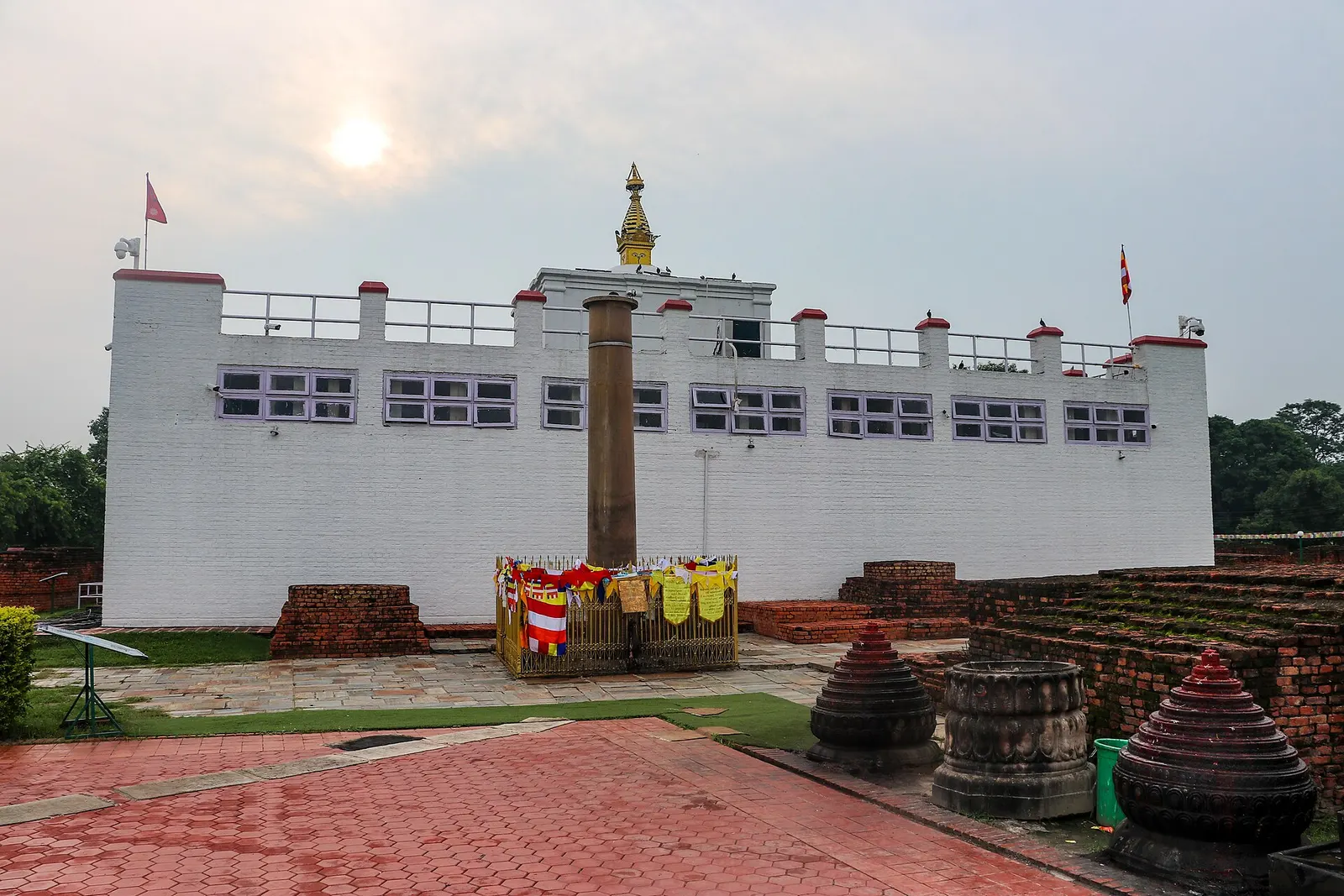
Lumbini
The birthplace of the Buddha in the Terai, a sacred garden with an Ashokan pillar, ringed by monasteries from across the Buddhist world.
Chitwan & Teraiरामग्राम स्तूप
A grassy, unexcavated brick mound near Parasi, revered as a stupa holding a share of the Buddha's relics.
Ramgram Stupa stands in open farmland on the bank of the Jharahi river, a short distance from Parasi bazaar, the headquarters of Parasi district in the western Terai. At first sight it is simply a low, tree-dotted mound of earth and brick, but Buddhist tradition holds that it is one of the eight stupas raised over the Buddha's ashes after his death, and the only one of them believed never to have been opened.
The site is quiet and largely undeveloped compared with Lumbini to the west. A walled enclosure surrounds the mound, with a few small shrines, prayer flags and trees around it, and visiting monks and pilgrims from Sri Lanka, Thailand, Myanmar and elsewhere come to circle it and make offerings. It is an easy half-day trip from Bhairahawa or a stop on a wider circuit of Buddhist sites in Rupandehi, Kapilvastu and Parasi.
Because the mound has never been fully excavated, there is no museum or large monument to see. The appeal lies in its age, its setting among rice fields and its place in the story of the Buddha's relics.
According to early Buddhist texts, the Buddha's relics were divided among eight claimants after his cremation at Kushinagar, and the Koliya people of Ramagrama built a stupa over their share. Later tradition says that when the emperor Ashoka collected relics to redistribute them in new stupas across his empire, he left the Ramagrama relics in place, and legend explains this by saying they were guarded by serpent spirits (nagas).
Chinese pilgrims who travelled through the region in the first millennium CE described a ruined stupa at Ramagrama, and modern scholars have linked those accounts with the mound near Parasi. Limited archaeological work has been carried out at the site, and Ramagrama has been proposed by Nepal for inclusion on the World Heritage List, but it is not part of the inscribed Lumbini property.
The surrounding villages are home mainly to Tharu, Madhesi and hill-origin communities, and local Hindu festivals are celebrated alongside the Buddhist visits. Buddha Jayanti, the full moon of Baisakh, is the busiest day at the stupa.
Walk around the stupa
Join pilgrims in a clockwise circuit of the mound and visit the small shrines in the enclosure.
Buddhist circuit
Combine Ramgram with Lumbini in Rupandehi and Tilaurakot in Kapilvastu over two or three days.
Parasi bazaar
Stop in the district headquarters for food, supplies and a look at a Terai market town.
Forecast for 100 m. Conditions change fast in the mountains.
Weather data: MET Norway, licensed CC BY 4.0. A forecast, not a guarantee.
Oct-Mar
Simple lodges in Parasi bazaar; most visitors stay in Bhairahawa or Lumbini, which have a wider choice.
No partner stays are listed here yet. List a property.
Ramgram lies near Parasi bazaar, reached by road from Bhairahawa, Butwal or the East-West Highway at Sunwal.
Nearest hub: Bhairahawa
None needed
No permit is needed to visit the stupa. Any donations or local charges are made on site.
Verify before travel: permit rules and fees change. Checked 2026-10-08 against Ramagrama stupa, Wikipedia.
What this place is typically exposed to, and when. These are seasonal patterns, not a report on conditions now.
Heatmoderate in a typical yearApr-Jun
April to June is hot on the Terai plains, often well above 35 C by midday; sightseeing is easiest early and late in the day.
Floodingmoderate in a typical yearJul-Sep
Heavy monsoon rain can swell the Jharahi and other Terai rivers, flooding fields and minor roads around Parasi in July to September.
Check current conditions before you travel
Roads, trails, passes and flights change with the weather and with roadworks, and nothing on this page describes conditions today. Before you set off, check the Department of Hydrology and Meteorology for weather and flood warnings, the Nepal Disaster Risk Reduction Portal for incidents, and the local authority, police or your licensed operator for road, trail and flight status.
Buddhist tradition holds it is one of the eight original stupas over the Buddha's relics, and the only one never opened.
No. It has been proposed for World Heritage status but is not part of the inscribed Lumbini property.
It is a drive of a couple of hours east of Lumbini by way of Bhairahawa, depending on the route.
A grassy brick mound in a walled enclosure with small shrines; there is no museum or large monument.
Temple, monastery or heritage site · 150 m
The birthplace of the Buddha in the Terai, a sacred garden with an Ashokan pillar, ringed by monasteries from across the Buddhist world.
Town or village
The headquarters town of Parasi district, a Terai market town and the base for Ramgram Stupa.
Town or village
A growing highway town in Parasi on the East-West Highway, a stopping point between Narayangarh and Butwal.
Town or village
A busy city where the Terai meets the hills, at the mouth of the Tinau gorge and the start of the Siddhartha Highway.